Grounds for Pause: The Quiet Ritual That Ends a Greek Meze Night
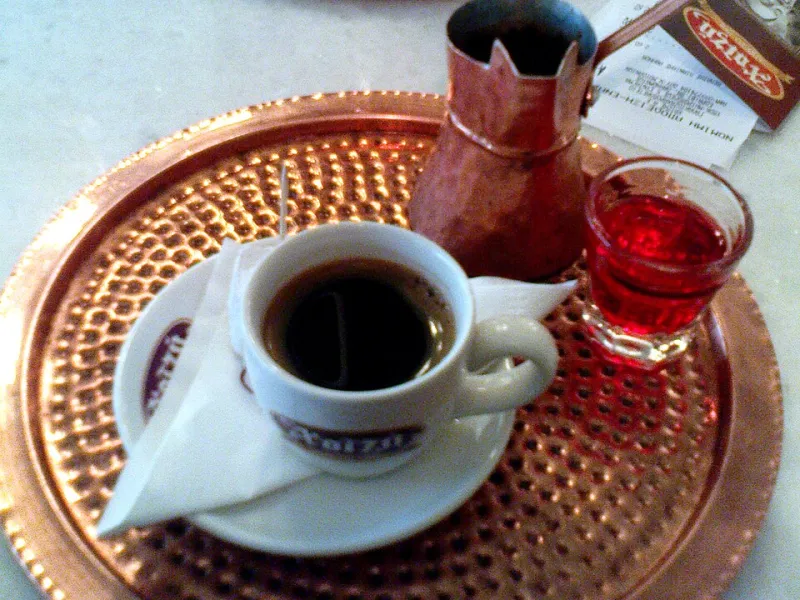
Photo: Antonio Fajardo i López, CC BY 3.0, via Wikimedia Commons
The plates are stacked at one end of the table. Someone has finally stopped pretending they are not going to finish the last of the bread. And then, almost as a formality, somebody says the word: coffee. Nobody leaves for at least another forty minutes.
Greek coffee is not a pick-me-up bolted on at the end of a meal. It is the punctuation mark. It changes the tempo of the evening from eating to talking, and it exists almost entirely to buy you more time at the table.
A Very Small Cup With a Very Long History
Coffee reached the eastern Mediterranean through Yemen and Cairo, arriving in the Greek world during the centuries of Ottoman rule, and it stayed long after the empire left. The coffee house became a fixture of Greek town life — a place for news, argument, politics and cards — and the drink itself settled into a form that has barely changed since.
What is now sold across Greece as ellinikos kafes is the same method you will find from Sarajevo to Beirut: very finely ground coffee, water, sugar, a small long-handled pot, low heat. In Greece it was once commonly called Turkish coffee; the name changed in the twentieth century for reasons that had nothing to do with the coffee. If you order it in a taverna today, you are drinking a method, not a nationality.
The Pot Is the Whole Equipment List
The pot is called a briki, or sometimes a kafebriki. It is a small conical saucepan with a long handle, wider at the base than the top, and it costs very little. Any small milk pan or butter warmer will do the same job. You do not need a machine, a filter, or a barista.
The coffee itself must be ground to a powder — finer than espresso, closer to flour. If you buy it from a Greek or Middle Eastern grocer it will already be right. Ask for 'Greek coffee, fine grind' and you will be understood.
Sketo, Metrio, Glyko
Sweetness is ordered, not added afterwards, because the sugar goes into the pot with the water and is cooked into the drink. Three words cover it:
- Sketo — no sugar. Bitter, bracing, and the choice of purists.
- Metrio — medium, roughly a teaspoon per cup.
- Glyko — sweet, two teaspoons or more.
It arrives in a small cup, roughly the size of an espresso cup, often on a saucer with a glass of cold water beside it and, if you are lucky, a loukoumi — a soft, rose-scented sweet dusted in icing sugar. The water is not decoration. It cleans the palate between sips and, frankly, helps with the grounds.
How to Make It at Home
For one cup: 60–70ml cold water, one heaped teaspoon of very finely ground coffee, and sugar to taste.
- Put the water, coffee and sugar into the briki before it goes on the heat. Do not add coffee to hot water.
- Stir once or twice, gently, to wet the grounds. Then leave it alone.
- Set over a very low flame. The slower it heats, the better the foam.
- Watch the surface. When a thick ring of foam (the kaimaki) forms around the edge and the coffee is about to rise, lift the pot off the heat. Do not let it boil over — that is the one real mistake.
- Pour slowly into the cup, aiming to keep as much of the foam on top as possible, and stopping before the grounds come out.
- Wait a minute. The grounds settle to the bottom of the cup. They are supposed to.
Do not stir it once it is poured. Do not drink the last centimetre. If you do, you will understand why nobody does.
The Foam Is Not a Detail
The kaimaki is the marker of a coffee made with care. It comes from slow heating and from leaving the liquid undisturbed, and it is the reason Greeks will tell you a coffee made in a rush is not worth drinking. If you have ever wondered why a Greek host seems so pleased with themselves after making coffee, this is why.
The Cup-Reading Business
There is an old custom of turning the cup upside down, letting the grounds dry, and reading shapes in them — kafedaki, cup reading, a parlour game somewhere between fortune-telling and gossip. It survives mostly as an excuse to keep sitting. Treat it as such and it is delightful; treat it as prophecy and you will be disappointed by the accuracy of coffee grounds.
Why a British Dinner Should End This Way
We are, on the whole, a nation that treats coffee as a signal to leave. The cup arrives; the bill follows; coats are found. Greek coffee makes that impossible, because it takes ten minutes to make badly and fifteen to make properly, and it comes in a cup you cannot hurry.
That is the appeal. It forces a pause at exactly the moment a good evening might otherwise dissolve into a taxi queue. It is also, for the record, much lower in caffeine than an espresso — the serving is tiny and the extraction is gentle — so it will not keep you up. You can have the second one.
Where to Find It in the UK
Most Greek and Middle Eastern grocers sell brikis for a few pounds and coffee ground to the right powder. In restaurants, ask for Greek coffee rather than espresso, and specify metrio if you are unsure. If a place serves it, it is usually a good sign about everything else — a kitchen that bothers with the last thing you order is generally a kitchen that bothered with the first.
Then sit back. The plates are cleared, the evening is not.