Crisp Edges, Full Table: Why Greek Pies Belong in the Meze Mix
With Bonfire Night behind us and the nights drawing in, the meze table starts to feel less like a summer lark and more like a proper autumn comfort. This is the moment Greek pies earn their place. A tray of filo, still warm from the oven, cut into rough squares and passed around with a bowl of olives, does more for a gathering than any number of fiddly canapés.
Pies are not a side note in Greece. They are breakfast, picnic food, a village celebration, a Tuesday lunch. And on a meze table they make quiet, generous sense: crisp at the edges, soft in the middle, easy to share and happy at room temperature. For a British kitchen in 2026, where supermarket filo is widely available and a bag of spinach is never far away, they are also remarkably doable.
A pie is a sharing plate in disguise
We tend to think of pies as individual portions, but Greek pites are built for company. They are baked in large trays or rolled into coils, then sliced into wedges or squares. That makes them natural meze material: no plating, no precision, no last-minute panic. You put one down, someone cuts a corner, someone else takes the middle piece because the edges look crunchier, and the table carries on.
They also travel well. A tray of pie can be made earlier in the day, left to cool, and served as part of a spread rather than as the hot main event. In Greece, room-temperature pie is not a compromise. It is the point. The flavours settle, the pastry stays crisp, and you are not tied to the oven while everyone else is already pouring drinks.
The four pies to know
Spanakopita is the gateway pie: spinach, feta, spring onions, dill and a little nutmeg, all wrapped in filo. In the UK, spinach works beautifully, but do squeeze it hard. Wet greens are the enemy of crisp pastry.
Tiropita is the cheese pie, and it is the one to make when you want something small and rich. Feta is classic, often with a little ricotta or Greek yogurt to soften the salt. Cut it into small squares; it is intense enough that a little goes a long way.
Hortopita is the green pie, made with wild greens in Greece and with chard, leeks, spinach or nettles here. It tastes more herbal and less salty than spanakopita, which makes it a useful counterpoint on a table full of cheese and olives.
Kreatopita is the meat pie, often made with minced lamb or beef, onions, herbs and sometimes rice. It is hearty, so serve it in smaller slices alongside lighter plates. Think of it as the pie that anchors the middle of the table while the vegetable pies work the edges.
Working with supermarket filo
Filo has a reputation for being fragile, but a little pragmatism goes a long way. Take it out of the fridge about 20 minutes before you start, and keep the sheets you are not using under a barely damp tea towel. It will dry out faster than you think.
Do not worry about tears. A patchwork of sheets is normal. Brush each layer lightly with olive oil or melted butter, work quickly, and use two or three sheets at a time rather than trying to handle one perfect sheet. If the pastry cracks, press it back together and carry on. No one at the table will inspect the joins.
For a crisper base, brush the top generously and cut the pie into portions before it goes into the oven. That way the steam escapes and the slices separate cleanly afterwards. Bake in a hot oven until deeply golden, then let it sit for ten minutes before cutting. If your filling is wet, add a spoonful of semolina or fine breadcrumbs to absorb the juices.
Make it earlier, serve it later
Pies are excellent make-ahead food. Assemble a tray in the morning, cover it and keep it in the fridge until you are ready to bake. Or bake it completely, cool it on a rack, and reheat it at 180C for ten to twelve minutes before serving. You can also freeze unbaked pie in portions and bake from frozen, adding an extra ten minutes to the cooking time.
Room temperature is perfectly acceptable for a meze spread, especially for tiropita and hortopita. If you are serving meat pie, a gentle warm-through is nicer, but avoid overheating it or the pastry will lose its snap. The golden rule is simple: cool leftovers quickly, refrigerate within two hours, and reheat only what you need.
A small pie-led spread for a British kitchen
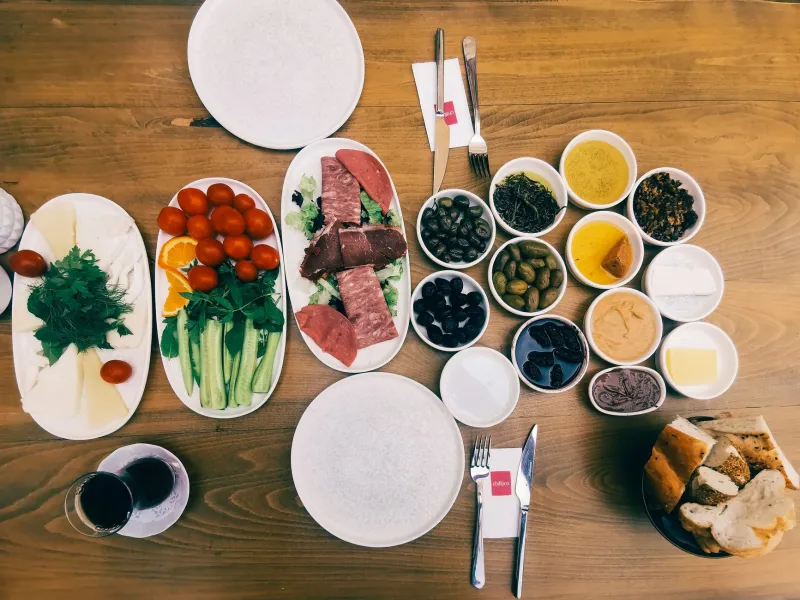
Start with a tray of spanakopita cut into large squares and a smaller dish of tiropita squares. Add a hortopita made with chard and leek, and one modest kreatopita sliced thin. Around them, put out cucumber, tomatoes, radishes, olives, a bowl of thick yogurt with mint, and some good bread. A glass of chilled white or a light red is plenty; the pies are rich enough without a fussy drinks pairing.
The beauty of a pie-led meze table is that it is forgiving. You can make one pie and buy the rest, or make two and freeze one for another evening. The table still looks generous, the edges are still crisp, and the plates keep moving. That is the phyllo effect: a little pastry, a lot of welcome.